The Orivon Project
Welcome to the Orivon Project documentation.
Here you will find every piece of information you need to know about the project and how you can become part of it.
We’re glad to have you here. This is an opportunity to help bring Web3 usage to the entire world.
Orivon is an idea willing to place new Web standards. If you believe in Orivon, Orivon is yours.
With the Orivon Foundation we simply do our best to drive the Orivon idea towards realization, for the benefit of everyone who shares the same vision and for the entire Web industry.
You may want to create your own independent Orivon movement and then choose to adhere to the Orivon Foundation or not
We accept decentralized leaderships which joins together to accomplish the same idea. It makes Orivon stronger.
Our final goal is to bring Web3 to the actual mass adoption.
The Ultimate Web3 Ecosystem
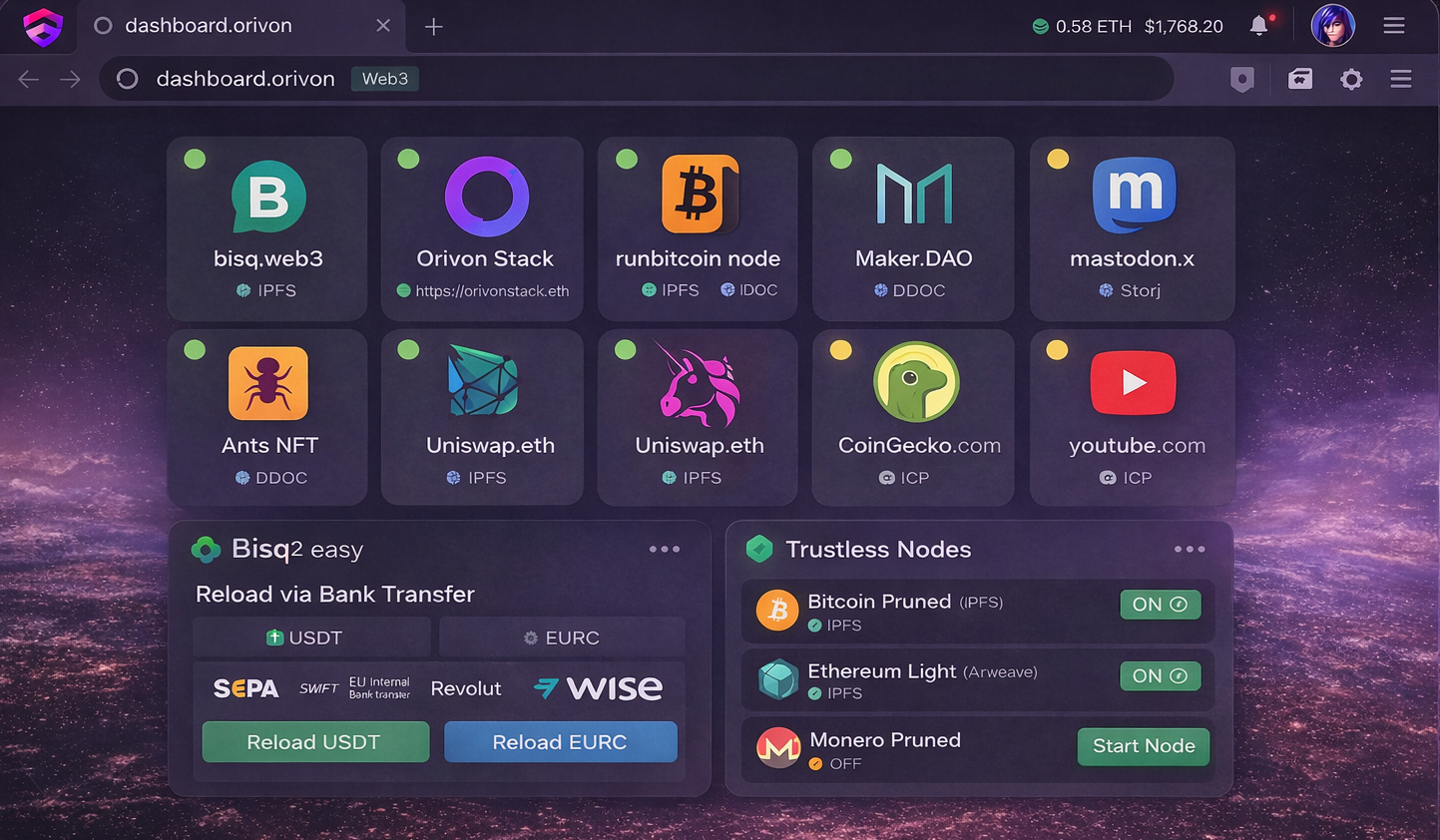 Take this only as an experimental and illustrative image
We believe we have created the perfect design for a truly Web3 browsing system of the future, and we share the Orivon Project ideals to make all of that possible.
Also, the idea of a truly Web3 browser seems inevitable for the Web3 future and would bring huge improvements to the user experience, as well as major improvements for developers building Web3 applications.
We are aware that our statements may sound impressive, but once you learn more about Orivon you may start agreeing with them as well.
Feedback, questions, discussions, and critiques are an important part of the project’s improvement and the general sharing of Web3 knowledge. Feel free to share your opinion through Discord or any of our channels.
Web3 Problems
One of the first problems preventing Web3 mass adoption is the absence of ease and clarity. People have no clear idea what Web3 actually is and what it isn’t (see the FTX case and its effect on public opinion).
Using Web3 is actually difficult for common users, involves high risks for them, and most people do not understand its values and use cases. Furthermore, most of what we use today isn’t even the actual trustless Web3, but rather a trusted Web2.5 temporary solution.
Normal browser limitations prevent running most Web3 components on the fly.
From a user’s perspective, everything is disconnected and nothing provides a clear Web3 experience worthy of broad public attention.
But this is understandable. Technologies take time until a way to make them easily accessible is discovered.
Orivon proposes to be that way.
Furthermore, there are some other reasons preventing Web3 from becoming widespread worldwide:
-
People think it has no practical use, and we cannot blame them. Only technical users fully understand Web3’s incredible value. When experiencing Web3 becomes easy for everyone, people will finally understand how game-changing it is.
-
We use Web2 solutions to access Web3 protocols. When you open uniswap.com, you are using a centralized DNS and gathering data from a central host (hoping it is not compromised).
The general public cannot take Web3 seriously if its current state is like this. We need to go truly Web3.
-
Going truly Web3 is only for technical users. Running interfaces locally, installing programs (and setting up wallets for each of them), running nodes, installing trustless DEXs like Bisq, these are activities mostly done by technical users.
For each Web3 operation it is currently download → install → open → setup… what if we could improve it to simply open?
This improvement would allow widespread adoption of Web3 social platforms, DeFi, Web3sites, and Web3 technologies in general.
-
There are no established ways to access Web3 resources:
How do I find Web3 things? How do I know if they are actually trustless? Is that even safe?These questions create uncertainty and insecurity for users.
We need an established method to access and search for valid Web3 resources.
The fact is that we all know these problems, along with Web2 solutions used to access Web3 protocols, are temporary and will eventually be replaced when the Web3 community comes up with a better solution.
But the solution is right here, it's called Orivon, and it aims to solve exactly all of that
Solution and Revolution
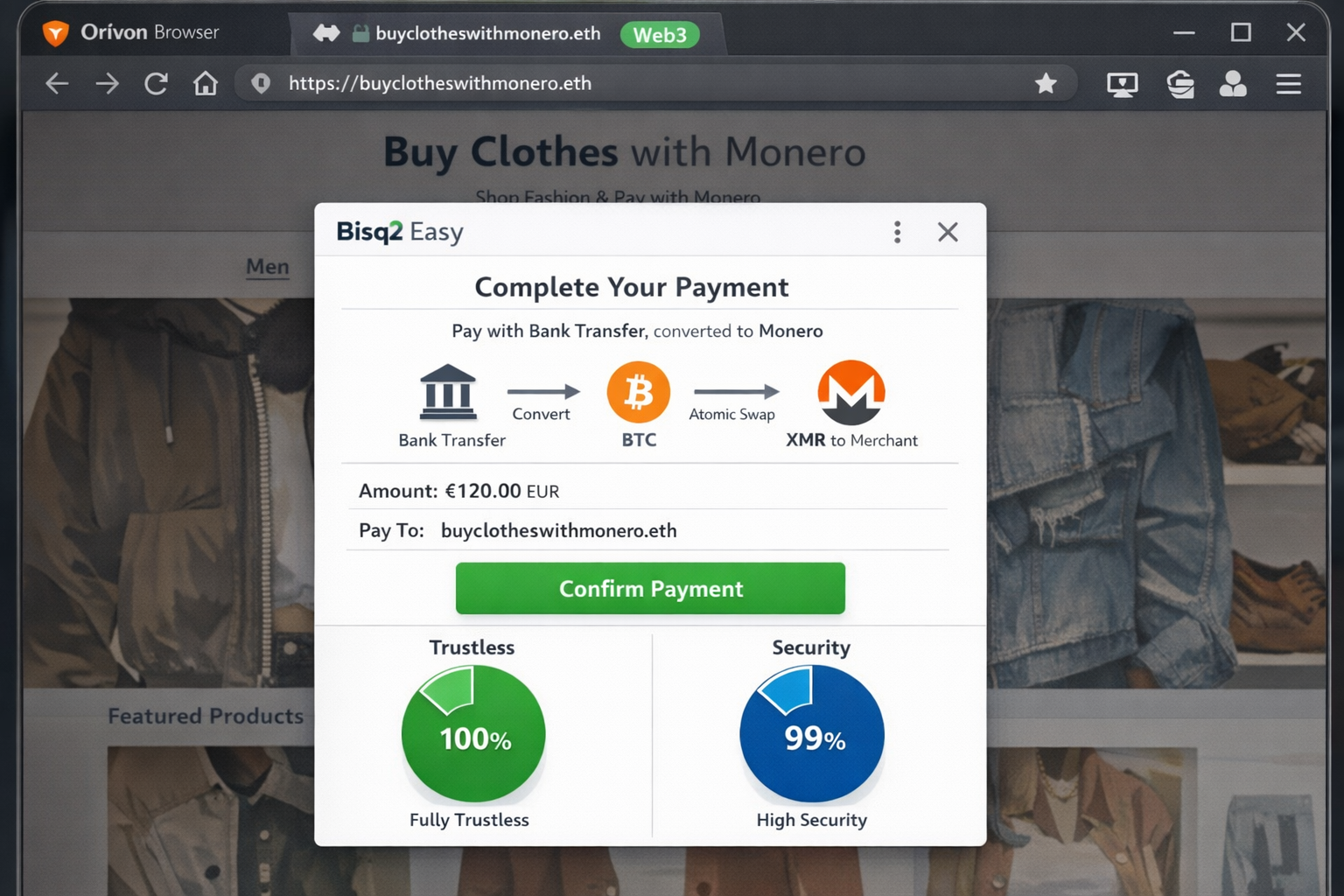 Take this only as an experimental and illustrative image
Orivon provides a solution designed to change the entire Web3 experience, both for users and developers.
Users will benefit from a huge UX improvement, easy search, and fast use of different Web3 clients simply by opening a URL (e.g., mastodon.eth). Users will also easily know how trustless and safe the currently visited site or operation is, possibly through a privacy indicator (Web3 Scores).
On-the-fly Web3 support will make everything far more seamless and straightforward for the user.
Feeling relaxed and safe while navigating Web3 has never been easier.
Developers will benefit from enormous time savings. They will only need to build frontend and protocol, things like wallet management, network management, and security are already handled within the Orivon Ecosystem.
Orivon Modules such as Wallets (to expand wallet capabilities) or Network management (to add new DNS or networks like Ethereum/Torrent) will be very easy to create inside the Orivon Development framework.
Developers will finally have a place to set new Internet standards based on Web3 needs.
Once a Web3 Module is created, the entire Internet industry will be able to benefit from it on the fly.
Building a Web3site following the Orivon model means building within a powerful ecosystem offering both ease of development and excellent user experience, encouraging large waves of users to adopt your product.
Orivon Implementation
It is now time to dive deeper into how Orivon actually works and how it aims to solve all of these problems while drastically improving the user experience.
Please note that the Orivon development process has not yet begun.
If you want to get involved and reserve a share of the Orivon DAO, please check the Get involved page.
Complete implementation details are available at Implementations.
But first, if you have not already done so, take a look at the main features down below
Applications Also called Special Extensions
Web3 is not just about supporting IPFS or a decentralized domain, it is about owning capabilities.
Besides IPFS, we may want to use Arweave, Torrent, the Ethereum blockchain, and more.
This is where the Applications system comes in.
Almost every component within the Orivon Ecosystem can be extended or modified by Apps.
They can be installed as easily as browser extensions or run on-the-fly by opening a URL. They include:
- Dashboard: The application used to display the dashboard in Orivon Browser tabs - Orivon Dashboard
- DNS Resolution - details
- Data Gathering (e.g., IPFS, Arweave, Blockchain, etc.) - details
- Accounts: Accounts are cryptographic keys holding methods. They could be based on mnemonic phrases, hardware wallets, abstraction, symmetric keys or anything else defined by App logic
- Crypto: Implementing a new cryptocurrency such as Monero, BSQ Tokens, etc.
- Address Lists: Creating new address lists derived from an implemented Crypto for all compatible Accounts (default lists, vanity generators, etc.)
- Network: Implementing access for networks such as Bitcoin, Tor, IPFS, Torrent, Bisq price nodes, etc..
- Web3 Score Provider: One or more providers can supply the data used for trustlessity and security scores
The Wallet System component offers an interesting opportunity for DeFi users. Some crypto systems, such as Bitcoin, Monero, ZCash, or BSQ, have never been trustlessly usable from a website.
This opens the door to decentralized applications for atomic swaps, escrow transactions with multisig or time-locks, and much more.
Web3 Scores: Trustless & Security
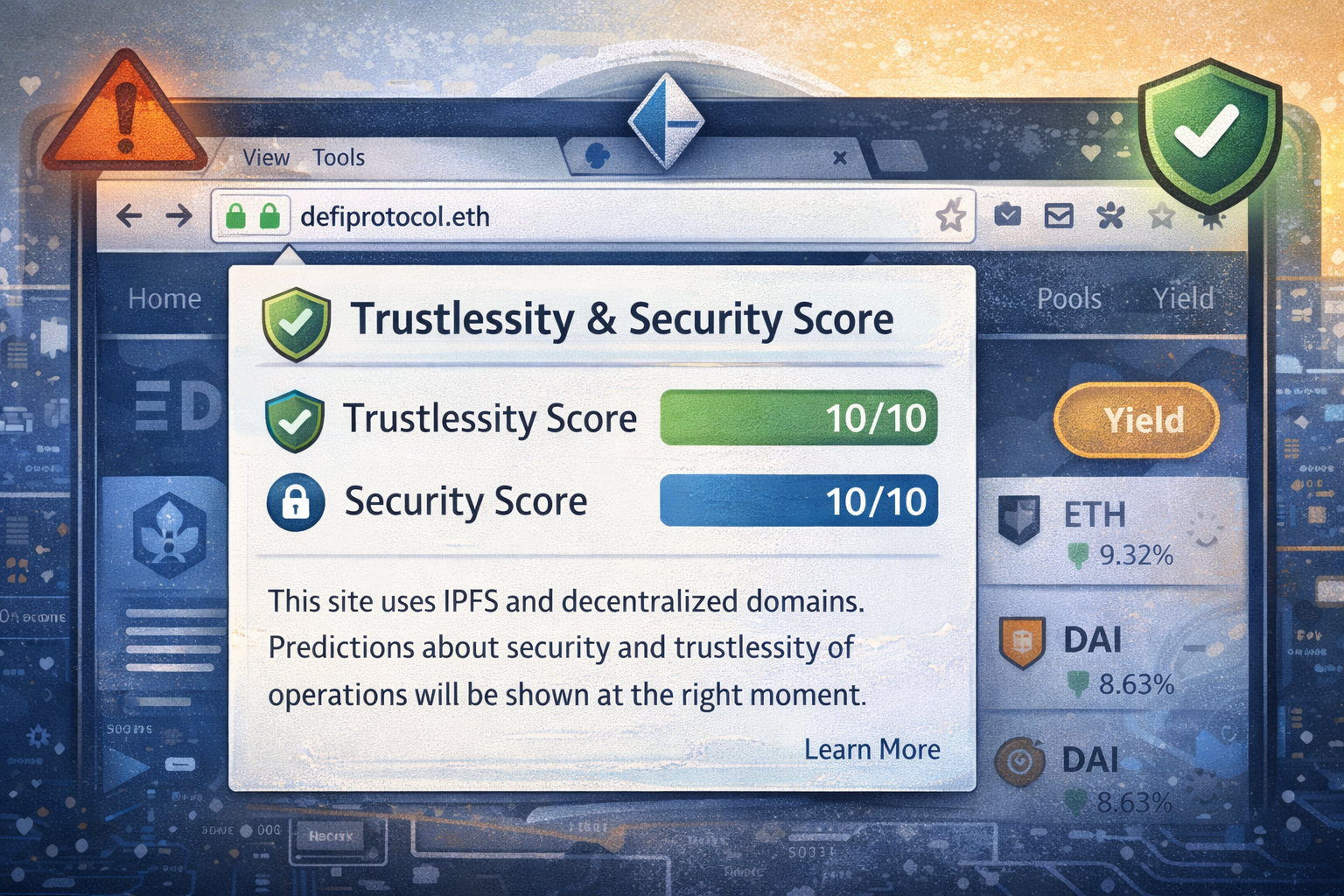 Take this only as an experimental and illustrative image
Trustlessity and Security scores are features that help users easily understand what they are interacting with.
They allow users to quickly understand:
- How trustless and truly Web3 something is
- How realistically safe a specific operation is
- (Bonus) Whether it reasonably preserves privacy
Imagine a user asking: “Is this site trustless? Is it Web3?”
If it is a .com site, it is not trustless.
If it is a .eth domain connected to IPFS, then yes.
But if it provides a bank IBAN to receive money without informing the user that the operation is not trustless, then it is not trustless.
If, without user control, it relies on data from centralized parties, it is not trustless, simple as that.
Users also need to know the safety of the operation they are performing. For example, you might yield a trustless stablecoin with an estimated 400% annual return, but that does not mean it is safe.
These two scores dramatically improve the user’s sense of safety and trust. They are a game-changer for bringing broader confidence to the Web3 space, with honest and realistic evaluations playing a key role.
So, who provides the evaluations?
How does the evaluation system work?
Advanced WASM: Programs on-the-fly
Current browser limitations force most Web3 codebases to become independent applications.
This is because browsers like Chrome or Firefox do not allow access to important network functions (which would allow opening a Bitcoin node or connecting to Torrent), have extremely limited storage access, limited CPU/GPU access, and restricted OS-level functions.
Orivon aims to allow access to these functions within a controlled and safe environment so that most Web3 codebases can run as Web3sites simply by opening a URL.
This means running a true Bitcoin node at bitcoinnode.eth, using Torrent by opening torrentclient.eth, using the original Mastodon client at mastodon.eth, running Bisq at bisq.eth, using Tor through torproxy.eth, and much more.
There is an ocean of possibilities. It completely changes how we perceive interacting with Web3 today.
It is a fundamental concept that should become the default in the Web3 ecosystem, and once you see it, you cannot unsee it.
FOR DEVELOPERS
You are free to use any language you want as long as it supports compiling to WASM.
For the frontend, development is exactly the same as modern frontend development. You can use HTML and its ecosystem, or continue using WASM with Canvas/WebGL/WebGPU.
This means that bitcoind from bitcoin-core could already run as a site on Orivon.
It would only require writing a web frontend to interact with it.
Other Features
WEB3 APP STORE
Orivon will include a store specifically for Applications or Modules that expands the browser’s capabilities.
As with the Web3 Score, if someone builds a better store with suitable Trustlessity, Security, and Privacy before us, we will adopt it as the default.
Otherwise, we will build it ourselves.
Implementation details of the store have not yet been finalized. To contribute, propose ideas in our docs repo or join our Discord.
However, we plan the following foundations:
- The store should prioritize results with the best Web3 Scores by client-side providers
- The entire store should be considered sufficiently Trustless, Secure, and Privacy-preserving
- UI and features inspired by F-Droid
WEB3 SEARCH
Web3 search engines will be integrated on Orivon Browser, possibly combining Web2 and Web3 indexing while prioritizing results based on Web3 Score.
Some example candidates we may collaborate with in the future include:
For now, treat them only as examples.
If none of them meet Orivon’s needs, we will be open to creating our own Web3 search engine.
INSTALLABLE WEB3SITES
By definition, if something is a Web3 site, it should be trustless, meaning it can run completely locally.
Whether downloaded or not, you remain in control of its Web3 Modules, such as Network, Data Gathering, and Crypto implementations.
DDOC
Domain Data Ownership Confirmation
DDOC can be seen as an additional security layer after HTTPS. It verifies that the data you receive is exactly what the domain owner intended you to receive.
It prevents incidents caused by remote server hacks and ensures data integrity.
DDOC requirements can be met by conventional hosts/IP data gathering (see Native DDOC Support) or directly by protocol design (such as IPFS).
This enables Web3 Score verification, since an identification string will always be available when DDOC is satisfied. Without DDOC, site data becomes unpredictable, making it impossible to evaluate safety reliably.
CONNECTION SETTINGS
Within Orivon Browser settings two new options will be available.
Nodes Configuration
Each Network App can add its own configuration fields to manage nodes, choosing what node to use, running a node locally, or selecting how it should run:
- Directly from the Network App itself (if supported)
- Through another App or Site capable of running that node
Socks5 Configuration
Apps can both create and use Socks5 proxies.
Apps providing Socks5 proxies will appear with their icon when needed, though custom Socks5 proxies (via IP address) can still be configured manually.
You can also set a global Socks5 proxy for the entire browser, although App proxy settings can override it.
Get Involved in the Orivon Foundation
Orivon aims to build a browsing and Web system capable of transforming the entire Web3 ecosystem with new standards and global adoption.
Orivon Foundation aims to make this vision real, and we need a strong community behind it.
It does not matter what your skills currently are. What matters most is your willingness to contribute your effort to supporting Orivon.
There are many valuable roles you can take. Once you get involved, your contributions will be remembered and rewarded with a fair amount of governance tokens in the Orivon DAO once it launches.
More details about Getting involved are available on the next page.