Orivon
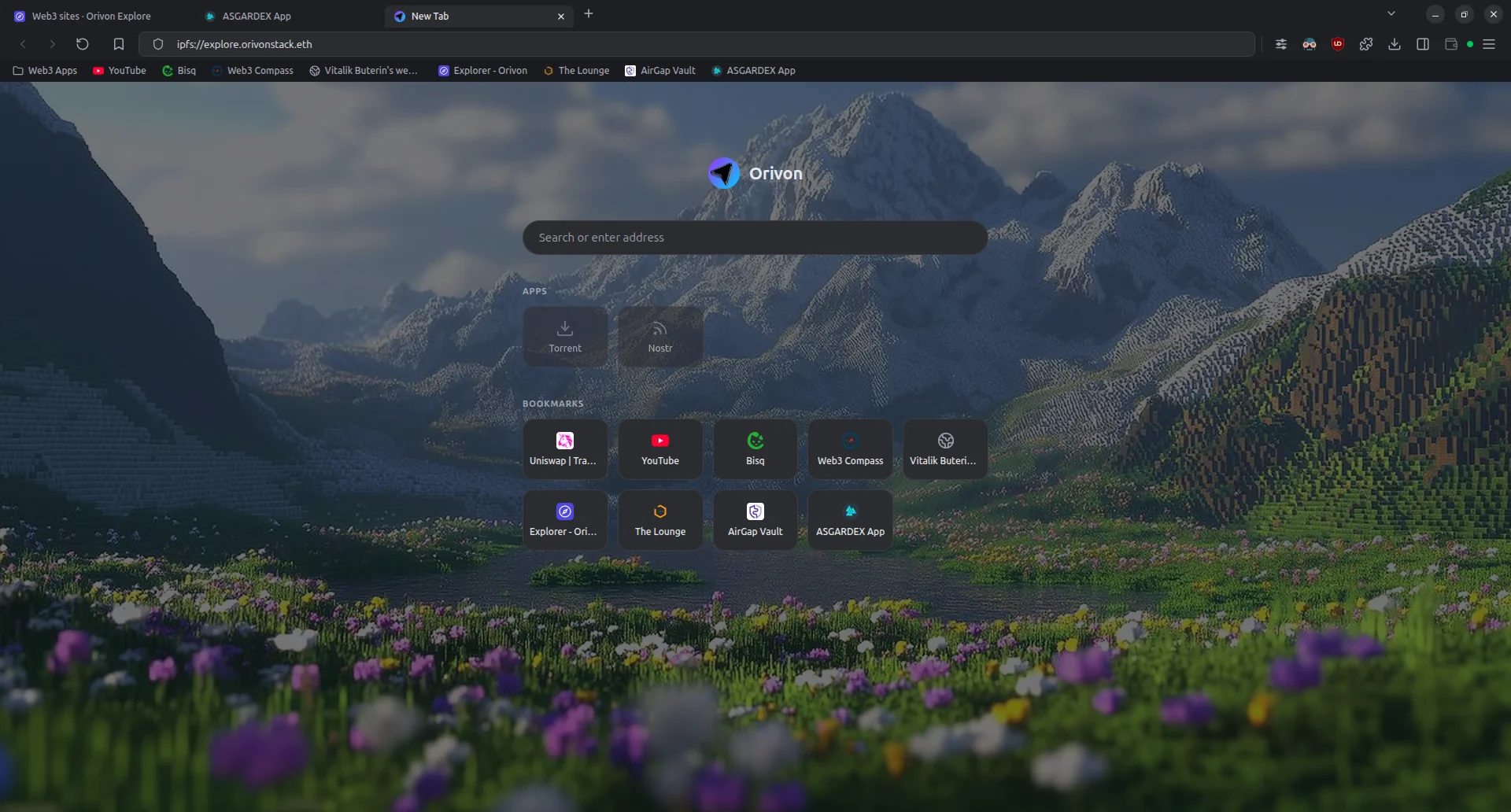
A browser built for owning. Open a link, and a desktop app, a peer-to-peer client or a whole Node.js server runs in your tab, verified on your machine and holding only the powers you grant it.
Why it exists
A web page cannot open a socket, join a peer-to-peer network, check a blockchain or keep a file on your disk. That is the browser's sandbox doing its job. It is also why decentralised protocols reach you through a middleman:
- the app at a
.comis found through a registrar's DNS and served from a company's server; - the chain is read through an RPC provider you never chose, and IPFS through a gateway that sees every byte;
- anything that needs a real socket becomes a download to install, update and trust on faith.
The protocol is decentralised. The road to it is not.
Orivon closes that gap. An app is still a web page at a link. It declares what it needs, you grant it in plain words, and Orivon enforces your answer on every call. Names and content are proven on your machine instead of taken on a server's word.
What you get
Desktop apps, from a link
FreeTube, Element and The Lounge run in a tab from a .eth name: upstream code, unmodified,
with nothing to install.
Every power is yours to grant
An app lists what it needs and you decide, in plain words. What it did not declare, it can never get.
Verified, not trusted
A light client on your machine proves .eth names, and every IPFS block is checked against its
hash.
A Web3 Score on every site
A shield in the address bar says whether you are on Web2, content you can verify, or open and trustless Web3.
No Orivon server in the path
No account, no cloud, no sync service. Your keys and data stay on your machine.
Your everyday browser, too
Chrome extensions with full uBlock Origin, profiles, tab groups, split view, and imports from the browser you use now.
Read, write, own
Web1 let you read. Web2 let you write, on someone else's servers. Web3 adds a third verb: own. The name you open, the code you run, your keys and the decisions about them.
Orivon is a browser for that third verb. Today it opens FreeTube, Element, The Lounge, AirGap Vault
and ASGARDEX from their .eth names. The direction is wider: any Web3 codebase, from a full node to
a DEX to a Tor proxy, running as a site the moment you open its name.
Start here
Download and install
Packages for Linux, Windows and macOS.
Quick start
Open your first app from a .eth name.
Build for Orivon
A web frontend and a manifest.
:::note Early access
Orivon is open source under AGPL-3.0 and in early access. Known limitations lists what it does not do yet, and the roadmap what comes next.
:::